
Commercial real estate lending is gaining real traction as we move into 2026, supported by measurable momentum in capital markets and improved access to debt. The Lending Momentum Index rose 112% year-over-year in the third quarter of 2025, hitting its strongest level since 2018, a clear signal that lenders are actively closing more deals and deploying capital more confidently.
For borrowers, investors, and brokers alike, this shift matters. After years of selective credit, unpredictable rate environments, and cautious underwriting, 2026 is shaping up to be a year when lending activity and transaction velocity both have room to expand. Understanding the trends shaping where capital is flowing, and where it’s tightening, will help you position financing strategies, negotiate better terms, and align your projects with the lenders most likely to support them.
In this blog, we’ll break down the commercial real estate lending trends expected to define 2026, so you can navigate the year ahead with confidence and strategic clarity.
Lending Momentum Entering 2026
Commercial real estate lending is gaining pace, but this cycle looks very different from past rebounds. Activity is picking up without a return to loose credit, signaling a market driven by discipline rather than speculation.
Several forces are shaping this momentum:
- Controlled rebound in deal flow: Loan origination activity is recovering after the 2024–2025 slowdown, but approvals are concentrated on transactions with clear fundamentals and realistic assumptions.
- Stronger lender confidence: Interest rate stability has reduced uncertainty, making underwriting models easier to stress-test and credit decisions more predictable.
- Selective capital deployment: Lenders are active again, yet focused on conservative leverage, credible sponsors, and assets with reliable income visibility.
- Wider financing availability for strong deals: Borrowers with clean structures and well-defined execution plans are seeing options across banks, private lenders, and blended capital sources.
Momentum is building, but it’s measured. Capital is moving back into the market with intent, rewarding preparation, and penalizing weak structure rather than chasing volume.
Interest Rate Stability and Its Impact on CRE Financing
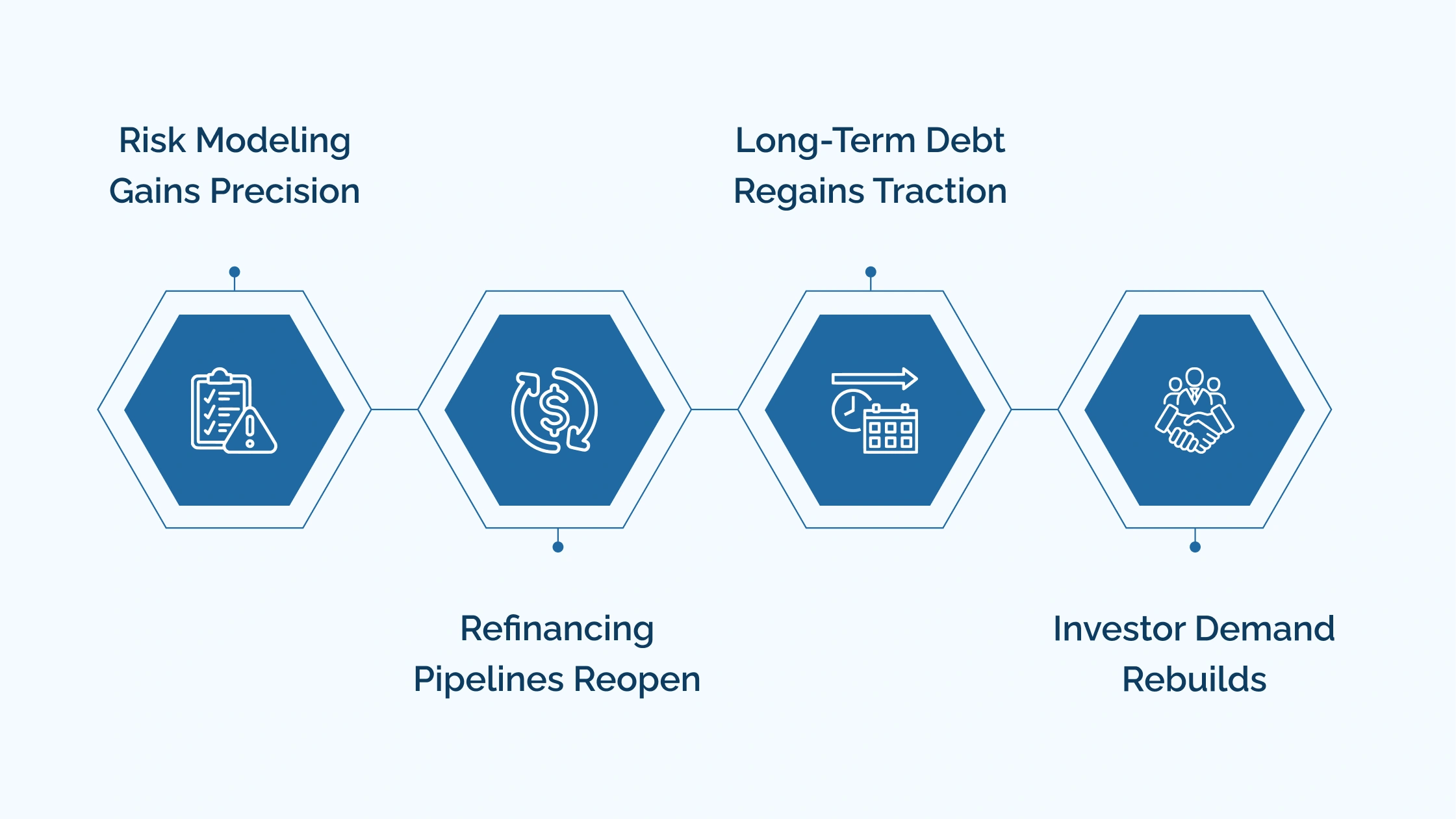
Rate volatility dominated lender decision-making over the past few years. Predictability has changed how commercial real estate financing is underwritten, priced, and executed. Stable borrowing costs are not loosening standards, but they are restoring clarity across the lending ecosystem.
Risk Modeling Gains Precision
Lenders can model risk with greater confidence when rates stop swinging quarter to quarter. That visibility supports firmer pricing ranges, clearer leverage limits, and fewer last-minute credit committee surprises. Instead of building wide buffers for uncertainty, lenders are tightening assumptions around asset quality, sponsorship strength, and exit viability.
Refinancing Pipelines Reopen
Stabilized rates have reopened refinancing conversations that were paused during peak volatility. Borrowers facing near-term maturities are re-engaging lenders earlier, allowing more structured recapitalizations rather than rushed extensions. Refinancing volume is increasing, but approvals favor conservative proceeds and realistic valuation expectations.
Long-Term Debt Regains Traction
Longer-term debt is back on the table where cash flow durability supports it. With rates more predictable, lenders can stress-test income projections more accurately and align loan terms with realistic operating performance rather than worst-case assumptions.
Investor Demand Rebuilds
Debt investors are re-entering the market with clearer yield expectations. Stable rates support pricing discipline while making senior and structured debt products more attractive relative to equity risk.
What borrowers should expect:
- More consistent pricing models: Fewer intra-quarter repricing surprises during execution
- Less rate shock, more structure scrutiny: Greater focus on leverage, cash flow durability, and exit credibility over headline interest rates
The Continued Rise of Non-Bank and Private Credit Lenders
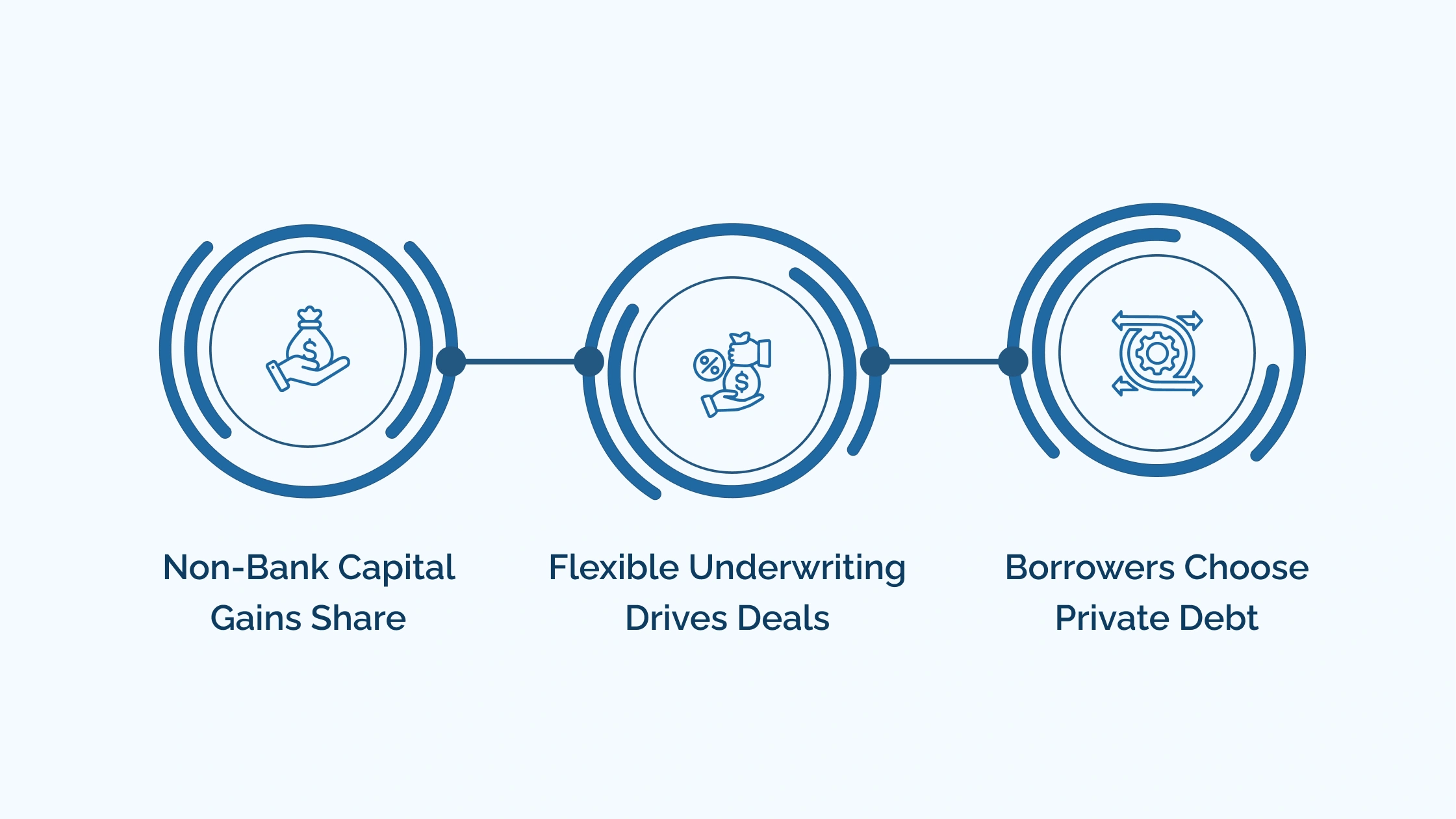
Commercial real estate lending in 2026 continues to tilt toward non-bank capital. Private credit providers are actively shaping how deals are structured, underwritten, and executed across the market.
Non-bank lenders operate with fewer regulatory constraints and more flexible capital mandates. That freedom allows them to respond faster to market shifts, price risk more dynamically, and structure loans around real-world deal conditions rather than rigid policy limits.
Non-Bank Capital Gains Share
Debt funds, refinancing mortgage REITs, and private credit platforms are capturing a growing share of non-agency originations. This shift reflects borrower demand for certainty of execution, especially as banks remain cautious on exposure limits and sector concentration.
Flexible Underwriting Drives Deals
Private lenders frequently underwrite based on asset-level performance and business plans rather than stabilized historicals alone. That approach aligns well with properties undergoing lease-up, renovation, repositioning, or ownership transition.
Borrowers Choose Private Debt
Borrowers are not choosing private lenders only out of necessity. Many are opting in because the structure fits their objectives.
- Asset-level cash flow focus: Loans sized around property performance rather than borrower balance sheets
- Custom loan structures: Interest-only periods, flexible terms, and tailored exit timelines
- Faster execution timelines: Streamlined approvals that support acquisitions, refinances, and time-sensitive transitions
Technology, AI, and Digital Lending Infrastructure
Technology is quietly reshaping how commercial real estate loans are underwritten, approved, and managed. Going into 2026, lenders are relying less on manual processes and more on digital systems to move deals efficiently while keeping risk controls tight.
AI-assisted underwriting helps review financials and market data faster, while automation streamlines everything from document intake to loan servicing. The result is a smoother process without loosening credit standards.
Impact for borrowers:
- Faster responses: Quicker initial feedback and credit decisions
- Clearer requirements: More consistent documentation expectations
- Shorter timelines: Less back-and-forth during underwriting and closing
Property-Type Lending Outlook for 2026
Lending activity in 2026 is highly asset-specific. Capital is available, but underwriting standards vary sharply depending on property type, sponsorship quality, and execution risk. Here’s how lenders are viewing the major sectors.
Office
Office remains the most challenged segment in commercial real estate lending.
- Continued underwriting pressure: Lenders are cautious due to occupancy risk and uncertain long-term demand
- Higher equity requirements: Lower leverage is common to offset valuation volatility
- Preference for repositioning plans: Clear strategies for conversion, lease-up, or redevelopment improve financing viability
Industrial
Industrial continues to outperform on the lending side.
- Favorable fundamentals: Demand tied to logistics, storage, and light manufacturing remains durable
- Smaller asset focus: Sub-institutional properties see the strongest lender interest
- Stable appetite: Underwriting remains consistent with fewer structural hurdles
Multifamily
Multifamily lending stays active, driven largely by refinancing needs.
- Ongoing refinancing demand: Loan maturities keep capital flowing into the sector
- Rent growth sensitivity: Conservative assumptions are standard in underwriting
- Operational efficiency focus: Expense control and management quality weigh heavily on credit decisions
Retail
Retail lending is selective and highly property-dependent.
- Asset-level bifurcation: Strong locations perform well while weaker assets struggle
- Necessity-based strength: Grocery, pharmacy, and automotive retail attract capital
- Experiential caution: Dining and entertainment concepts are evaluated case by case
Hospitality
Hospitality shows signs of stabilization, but lender caution remains.
- Gradual recovery: Activity has improved without aggressive leverage
- Conservative structures: Lower LTC and tighter covenants are common
- Sponsor experience weighted heavily: Operator track record often determines deal outcomes
Mixed-Use and Specialty Assets
These assets are underwritten with a local and execution-driven lens.
- Localized decisions: Market dynamics matter more than national trends
- Tenant mix importance: Income diversity and lease durability influence credit terms
- Execution risk sensitivity: Capital aligns closely with sponsor capability and project complexity
Lenders are backing well-structured deals. Property type sets the tone, but sponsorship strength, realistic assumptions, and downside protection ultimately determine access to capital.
Credit Quality, Delinquencies, and Risk Management
Even as lending volume rises, caution remains baked into credit decisions. Lenders are expanding activity without loosening discipline, shaped by how risk has played out over the last cycle.
Why caution persists despite higher volume
- Capital is available, but underwriting remains defensive
- Lenders are prioritizing downside protection over aggressive growth
- Deal structure matters more than headline demand
Uneven loan performance by asset class
- Stress remains concentrated rather than systemic
- Office and select hospitality assets continue to drive concern
- Industrial and well-located multifamily show more stable performance
Preference for restructures over charge-offs
- Lenders favor extensions, modifications, and recapitalizations
- Preserving value often outweighs forced liquidation
- Sponsor cooperation plays a central role in outcomes
Increased monitoring of maturing debt
- Loan maturity walls receive closer scrutiny
- Refinance feasibility is tested earlier in the loan lifecycle
- Cash flow durability drives extension and restructuring decisions
Higher lending activity in 2026 doesn’t signal relaxed standards. Risk management has shifted toward active oversight, early intervention, and structure-first underwriting rather than volume-at-any-cost growth.
Regulatory and Securitization Developments
Capital markets are playing a stabilizing role in supporting commercial real estate lending as 2026 approaches. Banks are finding ways to stay active without materially increasing balance-sheet risk, aided by tools that redistribute exposure rather than eliminate lending capacity altogether. This has allowed credit to continue flowing even as regulatory scrutiny remains elevated.
Synthetic risk transfers and loan participations have become especially important, enabling banks to manage CRE concentration while preserving origination momentum. At the same time, CMBS has returned as a viable funding channel, though with far more selective loan pools and tighter credit standards than prior cycles. Regulators are signaling a clear preference for focus and discipline over broad pullbacks, encouraging lenders to refine underwriting and risk management rather than stepping away from the market entirely.
Best Practices for Navigating CRE Lending in 2026
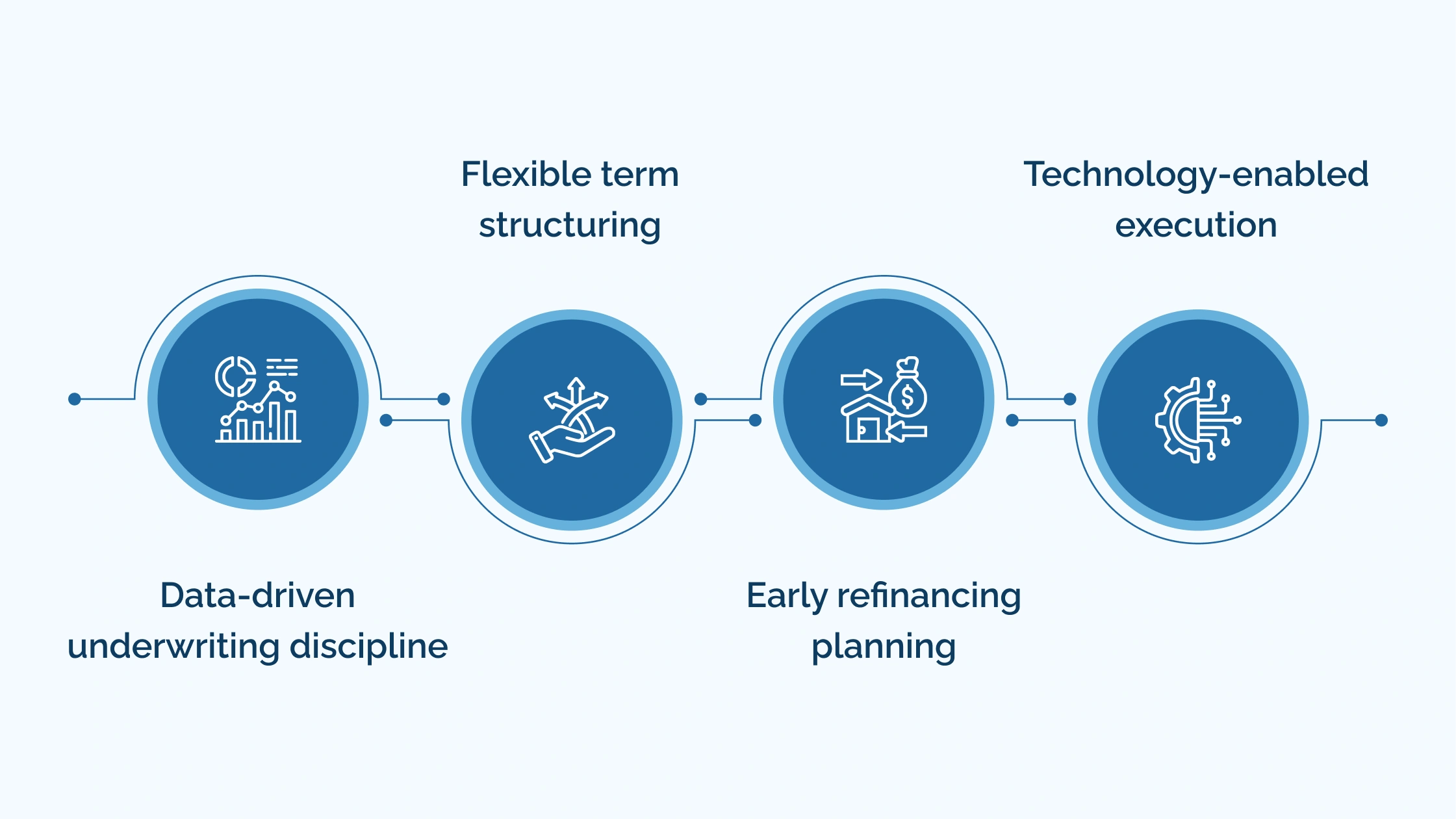
Successful borrowers and lenders are adjusting to a market that rewards preparation, clarity, and execution rather than aggressive leverage. Access to capital is available, but it favors well-structured deals supported by credible data.
- Data-driven underwriting discipline: Financials, rent rolls, and operating assumptions must be clean, realistic, and defensible. Lenders are relying more heavily on asset-level performance metrics to validate risk.
- Flexible term structuring: Interest-only periods, extension options, and phased capital deployment are being used to manage uncertainty without overexposing either side.
- Early refinancing planning: Exit strategies are being mapped well before maturity, especially with tighter credit filters and valuation sensitivity.
- Technology-enabled execution: Digital submissions, automated reviews, and real-time communication reduce friction and speed up decision-making, which can be a competitive advantage in active markets.
Borrowers who align with these practices position themselves as lower-risk partners in a more selective lending environment.
Make Confident Financing DecisionsWith Bluestone Commercial Capital

Commercial real estate lending in 2026 rewards borrowers who move decisively with the right structure and the right partner. Bluestone Commercial Capital works alongside investors and business owners to deliver financing solutions that match real-world timelines, asset conditions, and growth objectives, without unnecessary complexity.
Here’s how Bluestone supports your next move:
- Fast bridge financing for acquisitions, repositioning, and time-sensitive opportunities
- Fix-and-flip and transitional loan solutions tailored to value-add strategies
- Clear deal structuring guidance to help you navigate today’s selective credit environment
- Direct access to experienced capital partners who understand execution risk and timing
Let’s align your financing with how the market actually works. Explore options built for speed, flexibility, and informed growth.